
NDTScan provides ultrasonic pulse velocity (UPV) and pulse echo testing for structural assessment, quality control, and defect investigation across the UK from our Oxford base.
Two Distinct Methods
Ultrasonic Pulse Velocity (UPV)
UPV testing measures the travel time of a compressional sound wave through a known thickness of concrete. The pulse velocity correlates with compressive strength, density, and uniformity. The method is specified in BS EN 12504-4 and BS 1881-203. It requires access to opposite faces of the element (transmission mode) or to the same face (indirect mode with reduced accuracy).
UPV is used to: assess the uniformity of concrete across a structure or pour, identify zones of poor compaction or high void content, monitor the development of strength in early-age concrete, and provide supporting data for in-situ strength assessment alongside other methods.
Pulse Echo (Impact Echo)
Pulse echo uses a single-sided access method, making it applicable where only one face is accessible. A short mechanical impact generates a stress wave that reflects from internal boundaries, voids, delaminations, the far face of the slab, or tendon ducts. The reflected wave is captured and analysed in the frequency domain.
Pulse echo is used to: measure slab or wall thickness from one face, detect delaminations and voids beneath floor surfaces, assess grouting completeness in post-tensioned duct systems, and identify honeycombing in formed concrete elements.
When to Choose Ultrasonic Testing Over GPR
GPR and UT are complementary. Neither replaces the other in all situations. The choice depends on what you are trying to find and the access conditions:
- Use UPV when concrete quality, uniformity, or early strength is the primary question
- Use pulse echo when delamination, void detection, or thickness measurement from one side is needed
- Use GPR when you need to locate reinforcement, identify embedded objects, or map a large area quickly
- Combine UT and GPR for structural appraisal where both material condition and reinforcement configuration matter
Standards Referenced
NDTScan UT work references the following standards: BS EN 12504-4 (determination of ultrasonic pulse velocity), BS 1881-203 (measurement of velocity of ultrasonic pulses in concrete), ASTM C597 (standard test method for pulse velocity through concrete), and ACI 228.2R (nondestructive test methods for evaluation of concrete in structures).
Equipment
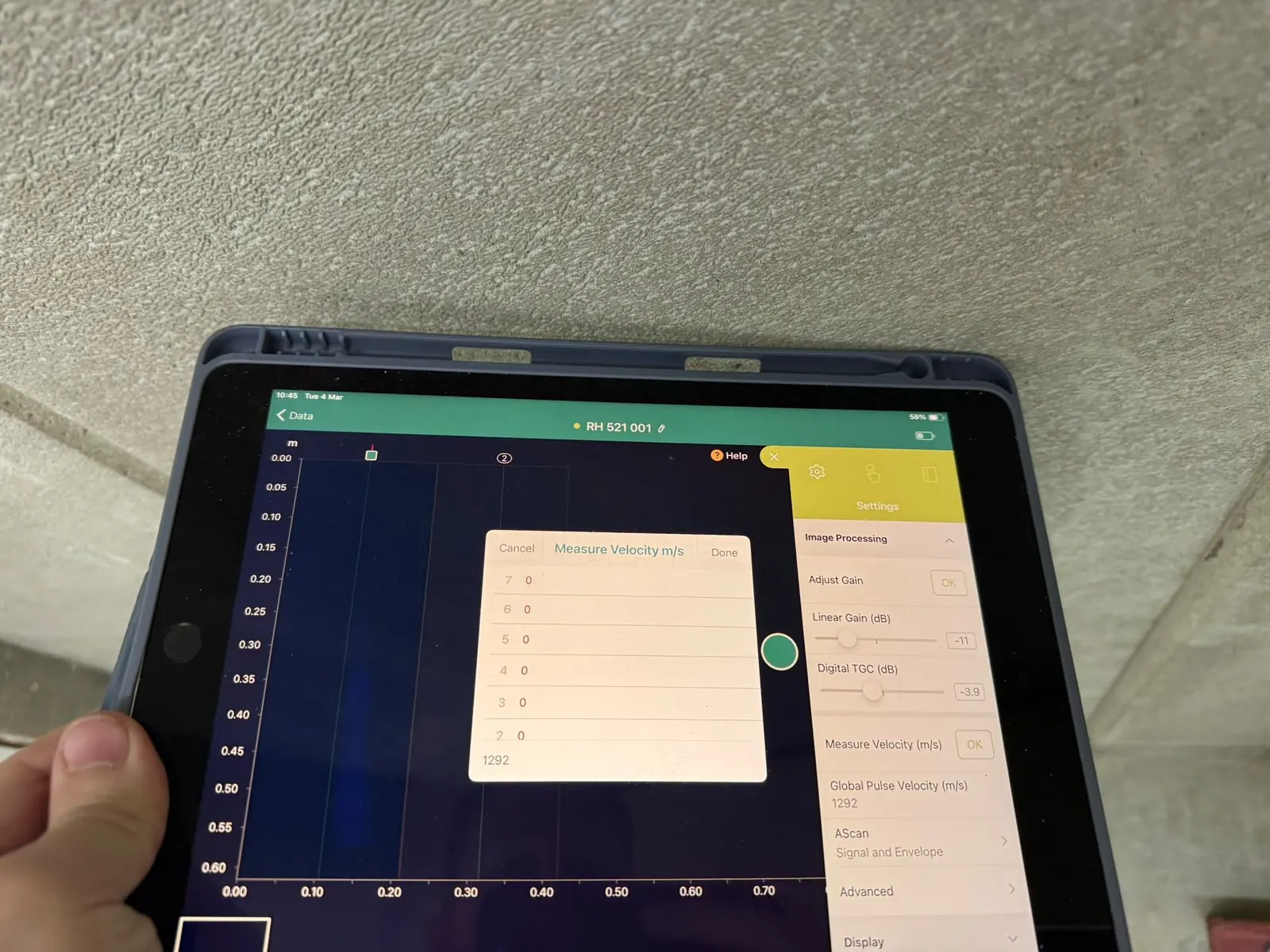
NDTScan operates Proceq Pundit PL-200 and Olympus 38DL Plus ultrasonic systems for concrete testing. Processing and analysis uses dedicated UPV and tomography software. All equipment is calibrated before each use with traceable calibration blocks.
Coverage
Ultrasonic testing services are available throughout the NDTScan service area: Oxford and Oxfordshire, London, Birmingham, Bristol, Reading, Milton Keynes, Cambridge, Southampton, and all areas within 100 miles of Oxford.
Frequently Asked Questions
What does UPV testing tell you about concrete strength?
UPV provides an indication of concrete quality and uniformity. Direct correlation to compressive strength is possible when a site-specific correlation has been established using cores, but BS EN 13791 and CIRIA Report C769 advise against using published general correlations alone for structural decisions. UPV is most valuable as a mapping and uniformity tool.
Can ultrasonic testing replace coring?
Not in isolation. Non-destructive UT results should be correlated with at least some destructive test data (cores or drilled samples) when making structural capacity assessments. UPV can significantly reduce the number of cores required by identifying where conditions are uniform and where anomalies warrant investigation.
What thickness of concrete can be tested?
UPV in direct transmission mode has no practical upper thickness limit for most structural elements. Pulse echo becomes less reliable at depths exceeding approximately 1, 1.5m. We advise on the most appropriate method after reviewing your specific conditions.
How does moisture content affect the results?
Saturated concrete shows higher pulse velocities than dry concrete of the same mix. For long-term monitoring or strength assessment, moisture condition should be noted and controlled where possible. We record moisture conditions during testing.
Concrete scanning guides
The questions behind most enquiries
How to identify RAAC
What RAAC looks like, where it was used, and what a visual check cannot tell you.
Read the guideScanning before drilling or coring
What happens on the day, what the marks mean, and what the contractor receives.
Read the guidePost-tension detection
How tendons are investigated in a post-tensioned slab, and when the engineer decides.
Read the guideRebar scanning
Bar position, spacing and estimated cover, and what a scan cannot tell you.
Read the guideFerroscan surveys
What the Hilti system does well, and where radar takes over.
Read the guideConcrete x-ray
Why radiography is rarely practical on site, and what replaces it.
Read the guideWhat clients and partners say
In their words
I have worked with Neil on a number of projects and have found him to be extremely knowledgeable in the fields of concrete scanning and structural repair. His approach to the task is very structured and professional, and communication throughout the project is always open and honest. I will be working with Neil again in the future, and I would happily recommend him.
I had the pleasure of working with Neil on a complex project involving structural remediation, where his expertise was key to our success. Neil was professional, knowledgeable, and solution-focused throughout. He worked seamlessly with the client team and brought the right attitude to every challenge.
Neil is an expert in his field, with a high level understanding of concrete scanning techniques, concrete repairs, and the technology that suits. He shows a keen interest in innovation and is open to learning new methodologies. I would highly recommend Neil to those seeking his services.