
The instruments
- Handheld radar. The Proceq GP8800 and GP8100 for reinforcement, tendons, conduits and thickness in slabs, walls and soffits where a cart will not go; the GSSI systems for larger areas. See GPR concrete scanning.
- Cover and diameter. The Hilti PS Ferroscan for cover mapping and diameter estimation close to the surface. See Ferroscan surveys.
- Ultrasonics for concrete. The Proceq Pundit 8050 and PL-200 for pulse velocity to BS EN 12504-4 and pulse echo from one face. See ultrasonic testing of concrete.
- Steel thickness. The Olympus 38DL Plus for remaining wall thickness through coatings. See thickness testing and corrosion mapping.
- Strength and surface. Rebound hammer and pull-off rig as part of a compressive strength assessment.
- Moisture and temperature. Protimeter moisture meters and FLIR thermal cameras for damp, leaks and missing insulation. See leak detection and moisture surveys.
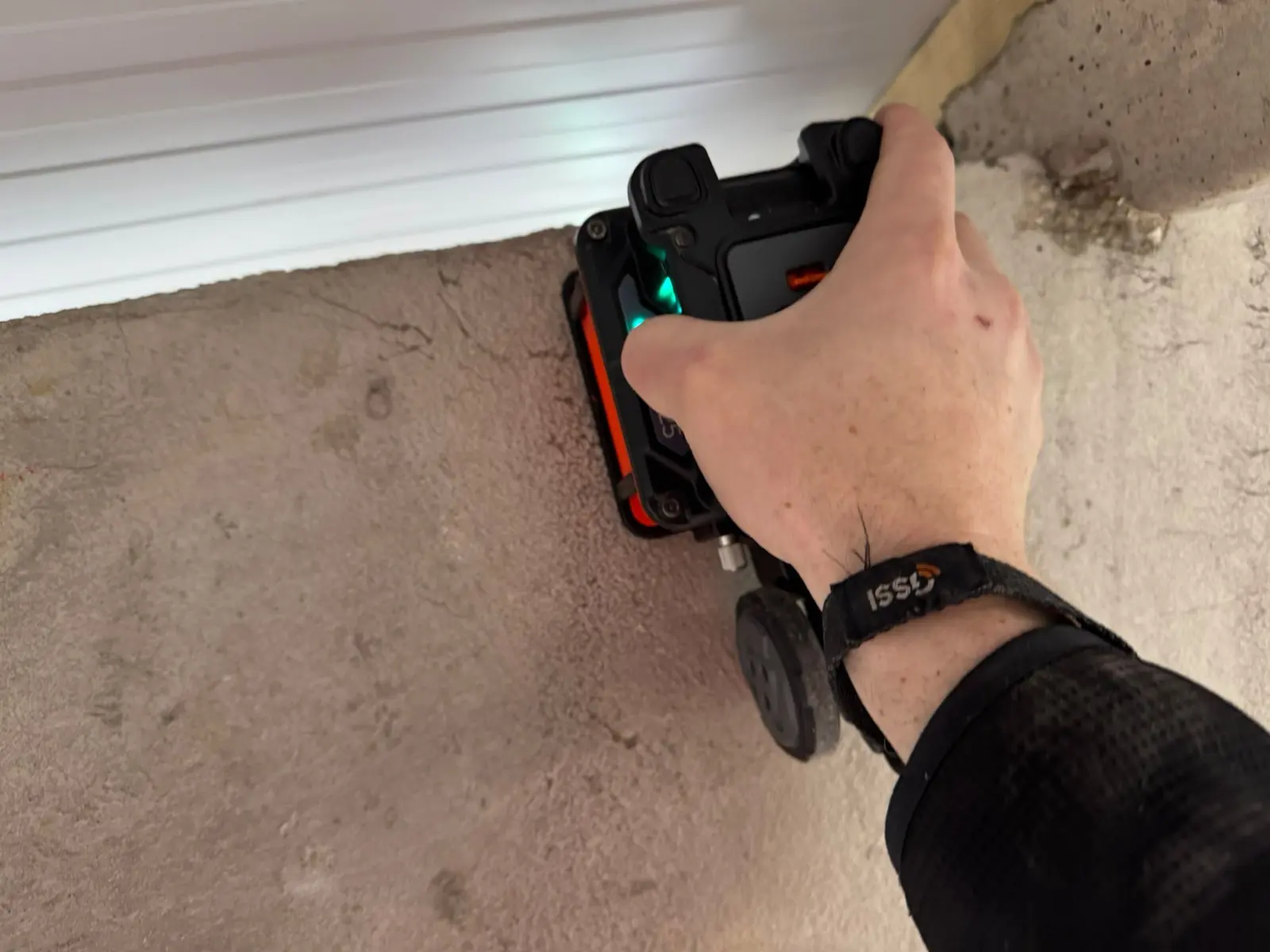
Where portable work happens
Basements and plant rooms, lift pits and risers, soffits from a scaffold or a tower, bridge piers from a boat, tank shells from a rope, live hospital and school estates during the working day, and railway and airport structures inside an access window. The instruments emit nothing that concerns a live site and take their readings from the surface, so the element stays in service. Rope access and confined-space entry are arranged through partners holding the certifications, with NDTScan's specialist taking or directing the readings.
What portable instruments cannot do
A handheld radar covers less area per hour than a cart and sees less deep than a low-frequency antenna; a Ferroscan reads one layer close to the surface; a thickness gauge reads the steel under the probe and nothing beside it; a rebound hammer alone does not give strength. The right instrument for the element is chosen before the visit, and the report states what each could and could not resolve.
What the engineer receives
The same report as any NDTScan survey: scaled plans of every area with the findings drawn in, depth, cover and thickness tables with the tolerance that applied, photographs, the equipment and settings, the standard applied, and the confidence attached to each finding. Instruments are calibrated by UKAS-accredited laboratories where the work requires it. The interpreted report follows within an agreed number of working days. The full kit is on the equipment page and under handheld inspection; NDTScan attends from Oxford anywhere in the UK, usually within one to two working days and same day where the diary allows.
Can you work in a live building?
Yes. The instruments are battery powered and emit nothing that concerns a hospital, a school, a data hall or a substation, and readings are taken from the surface with the element in service.
Is handheld scanning as good as a cart?
For the question it is chosen for, yes; for covering a floor plate quickly, no. The specialist picks the instrument for the element, and the report says which was used and why.
Questions we are asked
Can you scan a soffit from a scaffold or a MEWP?
Yes. Handheld radar, Ferroscan and ultrasonic units are used overhead from scaffolds, towers and platforms, with the data captured at the element and interpreted afterwards.