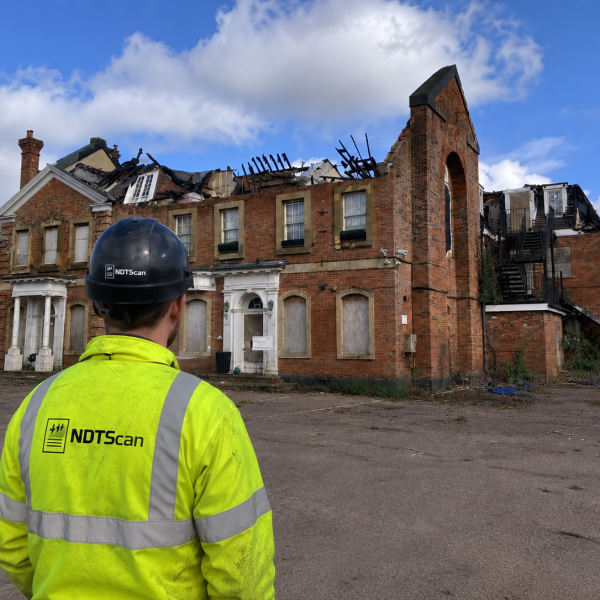
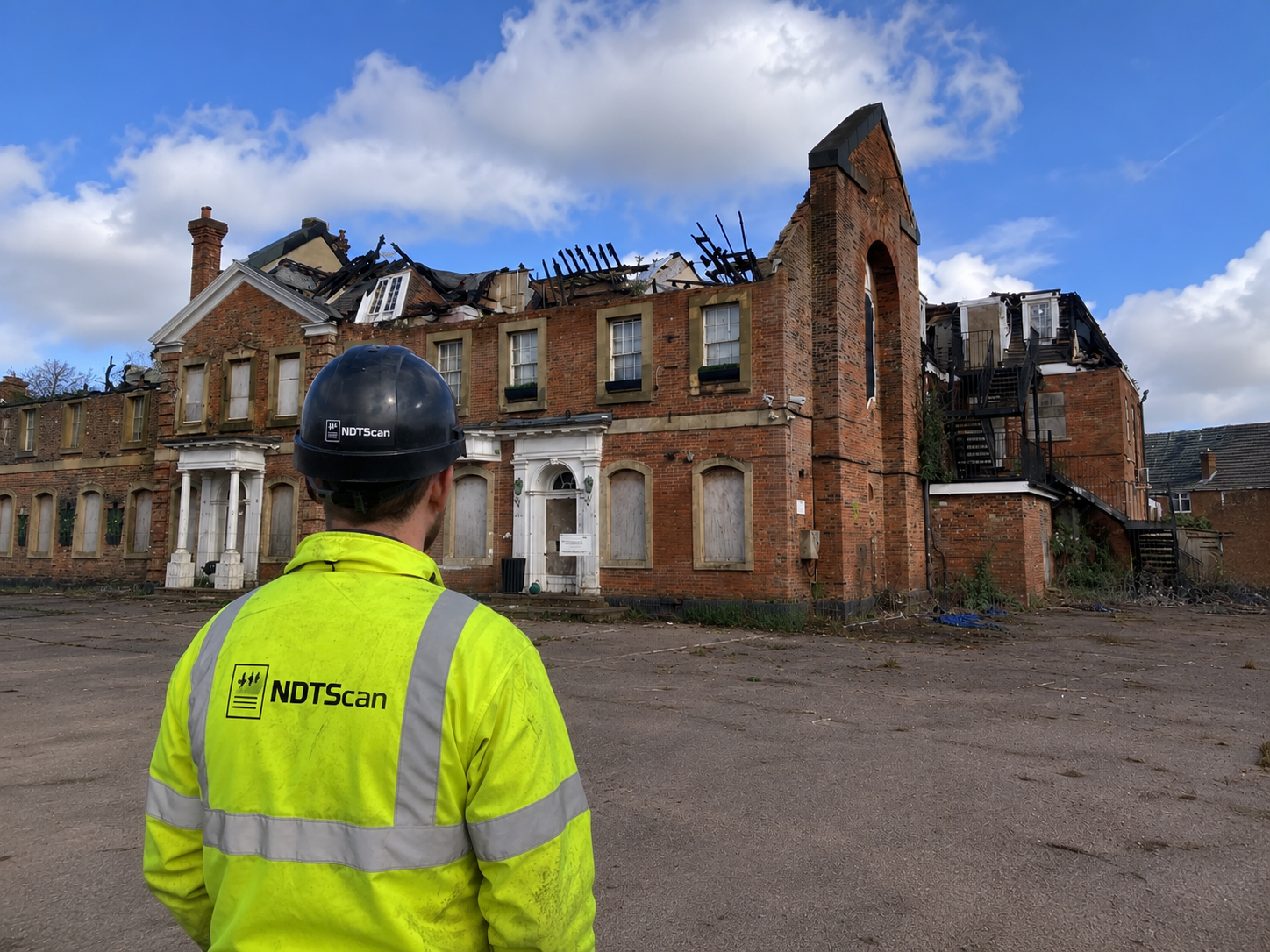
Scanning Fire Damaged Buildings in Oxfordshire
Following a severe fire at a commercial premises in Oxfordshire, the structural engineer required detailed scanning of fire damaged buildings to assess the integrity of the remaining concrete structure. NDTScan was commissioned to conduct non-destructive testing surveys to locate reinforcement, measure concrete cover depths and identify delamination within fire-affected slabs and columns. The data was essential to inform the structural appraisal and determine whether repair or demolition was the safest course of action.
The Challenge: Assessing Hidden Structural Damage After Fire
Fire exposure causes concrete to spall, crack and lose compressive strength, particularly when temperatures exceed 300°C. Visual inspection alone cannot reveal the extent of internal damage to reinforcement or the depth of heat-affected concrete. The client needed to establish the position and condition of steel reinforcement within heavily fire-damaged columns and floor slabs, but could not rely on original drawings due to discrepancies found during initial investigation.
Conventional cover meters were ineffective in areas where surface concrete had spalled or where high temperatures had altered the magnetic properties of the steel. Access was restricted due to structural instability, and the client required rapid survey mobilisation to maintain the programme for the insurance assessment and enable early decision-making on remediation strategy.
The NDTScan Solution: Multi-Method Concrete Scanning
NDTScan deployed ground penetrating radar using a Proceq GP8800 system fitted with a 2.6 GHz antenna to map reinforcement layout and identify subsurface voids and delamination across fire-affected slabs and beams. Cover depth measurements were taken at 100 mm grid intervals and processed to produce detailed reinforcement maps. Where GPR signal attenuation occurred due to moisture ingress or charred concrete, ultrasonic pulse velocity testing was conducted using a Proceq Pundit PL-200 to assess concrete quality and detect areas of reduced wave transmission indicative of thermal damage.
All surveys were conducted in accordance with BS 1881-203 and the client's CDM-compliant site safety plan. Data was georeferenced and overlaid onto site plans, with anomalies flagged for structural review. Our UKCSS-accredited technicians worked alongside the demolition contractor to ensure safe access and complete coverage of critical structural elements within a two-day site programme.
The Results: Informed Structural Appraisal and Safe Demolition
NDTScan provided CAD drawings showing reinforcement positions, cover depths and zones of probable thermal damage across 450 m² of fire-affected structure. The survey identified three columns where reinforcement cover had been reduced to less than 15 mm due to spalling, and highlighted delamination exceeding 40 mm depth in two slab areas. This data enabled the structural engineer to specify targeted demolition of compromised elements while retaining sections of the structure that remained serviceable.
The client avoided unnecessary full demolition, reducing waste removal costs and programme time. The non-destructive approach eliminated the need for destructive breakouts in unstable areas, improving site safety and accelerating the insurance claim process.
Frequently Asked Questions
- Can GPR detect reinforcement corrosion caused by fire exposure?
- GPR identifies the position and depth of reinforcement but does not directly measure corrosion. However, changes in signal amplitude and the presence of delamination or voids around bars can indicate corrosion-related concrete degradation. For corrosion assessment, half-cell potential mapping or resistivity testing is recommended alongside GPR surveys.
- Is it safe to conduct concrete scanning surveys on fire damaged structures?
- All surveys on fire damaged buildings require a site-specific risk assessment and structural engineer approval before access. NDTScan works under the principal contractor's health and safety plan, uses non-contact methods where instability is identified, and can deploy rope access or MEWP-mounted equipment to avoid loading compromised floors or working beneath unstable elements.
- What standards apply to concrete scanning surveys on fire damaged buildings?
- Surveys are conducted in accordance with BS 1881-203 for ultrasonic pulse velocity testing and ASTM D6432 for GPR. Reports include methodology statements, equipment calibration certificates traceable to UKAS standards, and georeferenced CAD drawings. Data is provided in formats suitable for structural appraisal to BS EN 1992-1-2 (fire design of concrete structures).
Need Concrete Scanning for Fire Damaged Structures?
NDTScan is UKCSS accredited and provides UKAS-traceable concrete scanning, GPR surveys and ultrasonic testing for structural assessments following fire damage. Contact our team for rapid mobilisation and nationwide coverage, with reports delivered to support your structural appraisal and remediation planning.
Facebook
Twitter
Email
Print
Newsletter
Get exclusive deals by signing up to our Newsletter.
You may be interested in:
May 25, 2026

May 19, 2026
May 12, 2025
May 12, 2025
May 12, 2025
02080
888 724
info@ ndtscan.com